
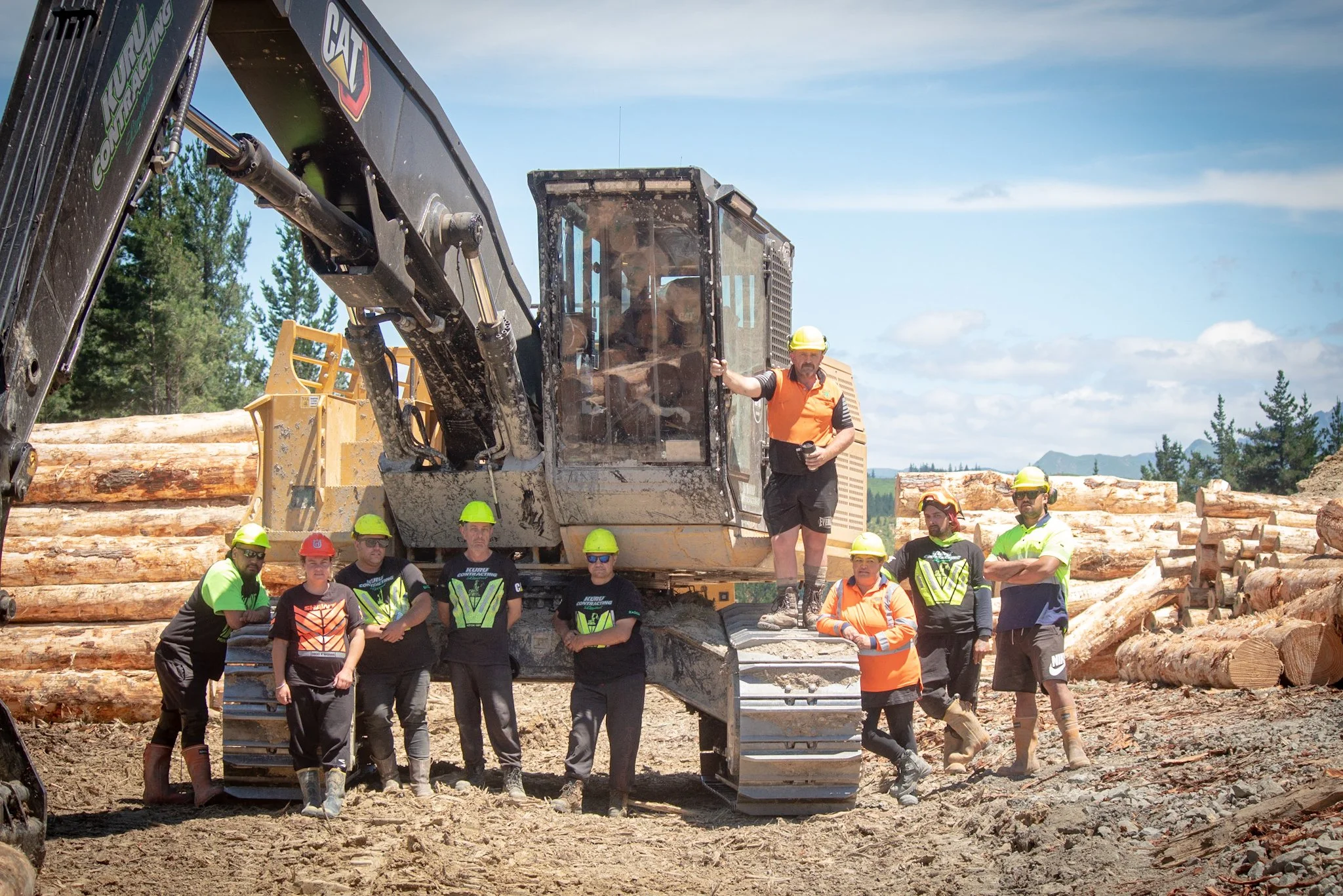
Kuru Contracting was established in 1997 by father and son Jack Kuru and Ricky Kuru. Its roots were planted firmly in roadline logging, with Ricky Kuru working hands-on alongside the crews and building his experience from the ground up.
Those early forestry years were not simply the beginning of Kuru. They were the years that shaped it.
When Ricky talks about Kuru as it was 20 or more years ago, he often comes back to one thing: Whānau.
It was a much smaller business then, but people were close. They worked hard together, looked after one another and did what needed to be done to get the crew through the day. There weren't company values written on the wall telling people how to behave. Operating as whānau was simply how Kuru worked.
And much of that culture was built in the forest.
Long before Kuru Contracting became the wider group of businesses it is today, its identity was taking shape in the forests of Te Tairāwhiti. It was built through early starts, steep country, changing weather, demanding production targets and the responsibility of keeping people and machinery working safely.
Forestry is an industry where no one works alone. Every operation depends on the crew around it. Fallers, machine operators, breaker-outs, skid workers, foremen, roading crews, mechanics and support staff all have a part to play. When something goes wrong, everyone feels it. When things go well, it is because people have worked together to make it happen.
That reliance on one another helped create something that would become an important part of Kuru's identity: People backing people.
The work was physically demanding, highly skilled and often unpredictable. Weather could bring production to a stop. A machine breakdown could affect an entire crew. Changing ground conditions and difficult terrain meant problems had to be worked through quickly and practically.
Those challenges helped shape the resilience and problem-solving that became part of the Kuru way of doing things. You learned to adapt. You learned to rely on the people around you. You shared what you knew, helped the next person coming through and got on with the mahi.
As Kuru grew, the machinery and technology grew with it. What began with roadline logging developed into mechanised harvesting capability across Roadline, Harvestline, Tower Yarder and Swing Yarder operations. Kuru's public history today describes almost 30 years of roadline logging and the development of those wider mechanised harvesting capabilities.
But the story was never just about the machines.
Every new piece of equipment needed someone to learn it, operate it, maintain it and understand where it fitted within the wider harvesting operation. People learned on the job, gained experience across different machines and operations and passed that knowledge on to those following behind them.
Some went on to become skilled operators, foremen and managers. Others carried the experience they gained in forestry into different roles and different parts of the industry.
That is an important part of the Kuru story.
The company was built by the amazing people who became part of our whānau.
People willing to work hard, learn, adapt, solve problems and back one another. For Ricky, the closeness of those early crews and the way people operated as whānau became something worth holding onto as the company grew.
Forestry also taught Kuru the importance of relationships. Long-term work could not happen without trust between crews, managers, clients, landowners, suppliers, mechanics, hapū, iwi and the communities surrounding those forests.
There are important conversations happening across Te Tairāwhiti about forestry, climate change, our whenua and what the future should look like for our region. We respect the need for those conversations, and we have been part of those discussions.
But as we tell the story of nearly 30 years of Kuru, we also need to be honest about where we have come from. Forestry is a big part of our story. It helped build our people, our skills and our business, but perhaps most importantly, it helped shape the whānau culture that Kuru continues to pride itself on today.
Whatever the future of forestry looks like in Te Tairāwhiti, those years, those crews and their mahi will always be part of the Kuru story.
Over the years, the industry has changed. Forestry has always been affected by weather, markets, client requirements, environmental responsibilities and the availability of skilled people and reliable equipment. More recently, the industry and our region have faced severe weather events, increasing environmental expectations and considerable uncertainty.
Through those changes, Kuru continued to develop. Training, competency, planning, environmental management and safe work practices became increasingly formalised. The business became bigger and its systems became more sophisticated.
But underneath it all was something much simpler: Look after your people, take responsibility for your mahi, back your crew and get the mahi done.
In 2012, Ricky and Leanne Kuru purchased the business and continued building on the foundations established during its first 15 years. Kuru's public history describes that change in ownership as the continuation of a family legacy that has since grown into a diversified, whānau-owned business operating across Tairāwhiti and Hawkes Bay.
As the company grew, the informal culture of those earlier forestry crews became something Kuru increasingly recognised as important to protect.
Today, the language might be more formal. We talk about good people, strong teamwork, striving for excellence, taking pride in our work and creating a caring, team-oriented culture. Those principles are reflected in Kuru's own quality systems today.
But the values behind those words began long before they were written down. They were already there in the forest and they were there in the crews who relied on one another, in the experienced hands teaching someone new, in the people who worked through breakdowns, bad weather and hard days together and in the relationships built over years of working alongside one another.
And in a business that, at its heart, operated as whānau.
As Kuru eventually began developing capabilities outside forestry, it took much of what had been learned in the forest with it: skilled people, experience with heavy machinery, practical problem-solving, relationships, resilience and a willingness to step up when opportunities arose.
But those are stories for another chapter.
Because forestry was never simply a stepping stone to something else, it is part of Kuru's whakapapa.
Nearly 30 years on, the machines, systems and size of the operation may look very different, but much of what defines Kuru was forged during those years in the forest: Hard mahi, capable people, strong crews, trusted relationships and a belief that we look after our own.
Kuru Contracting has grown. The work has changed and the whānau has become much bigger.
But the culture Ricky remembers from those early forestry years remains something worth holding onto because before Kuru had divisions, systems and written values, it had its people, and it was built in the forest.
In Chapter Three, we'll look at how the skills, people, machinery and relationships developed through forestry began creating new opportunities for Kuru, and how the business started to grow beyond the forest.